



Common Cooking Terms Explained in Plain English
Common Cooking Terms Explained in Plain English
Teaser: Recipes are much easier to follow when you understand the words they use. Here’s a beginner-friendly guide to common cooking terms, explained simply with practical examples.
Quick Summary
Cooking terms are the shortcut language of recipes. Words like sauté, simmer, dice, and fold tell you how to prepare ingredients or cook food. Once you know what these terms mean, recipes become less confusing and much easier to follow.
Why Cooking Terms Matter
If you are new to cooking, recipe instructions can sometimes feel like they were written in another language. A recipe might tell you to “mince the garlic,” “simmer the sauce,” or “fold in the whipped cream” without explaining what any of that means.
The good news is that most cooking terms are simple once you learn them. Understanding these words helps you:
- Follow recipes with more confidence
- Avoid overcooking or undercooking food
- Prep ingredients the right way
- Use your time in the kitchen more efficiently
- Make better substitutions and adjustments
Think of this glossary as a friendly kitchen translator.
Basic Cutting and Prep Terms
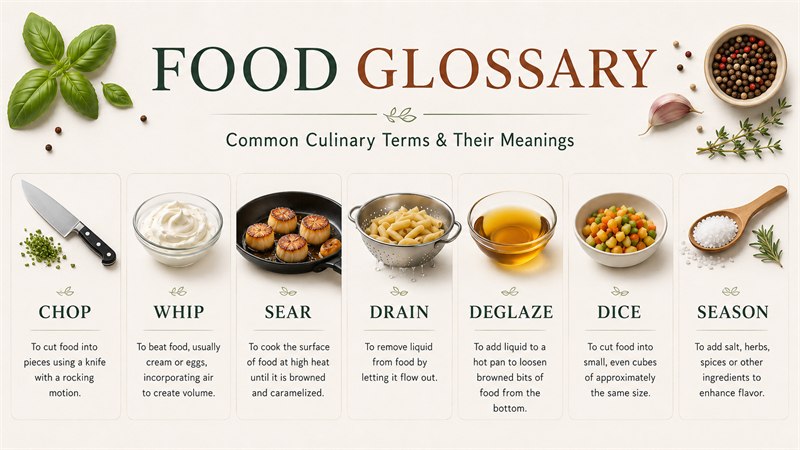
Chop
Chop means to cut food into pieces. The pieces do not have to be perfectly even unless the recipe says so.
Example: “Chop one onion” usually means cut it into small-to-medium pieces that will cook evenly in a soup, stew, or stir-fry.
Dice
Dice means to cut food into small, even cubes. Diced pieces are usually smaller and neater than chopped pieces.
Example: Diced carrots are often used in soups because small, even pieces cook at the same rate.
Mince
Mince means to cut food into very tiny pieces. This is common with garlic, ginger, herbs, and onions.
Example: “Mince two cloves of garlic” means cut the garlic as small as you can so the flavor spreads through the dish.
Slice
Slice means to cut food into thin, flat pieces.
Example: You might slice tomatoes for a sandwich, slice onions for fajitas, or slice apples for a pie.
Julienne
Julienne means to cut food into thin matchstick-shaped strips.
Example: Julienned carrots or bell peppers are often used in salads, stir-fries, and fresh spring rolls.
Cube
Cube means to cut food into larger square pieces than dicing.
Example: A stew recipe may ask you to cube beef or potatoes into bite-sized chunks.
Peel
Peel means to remove the outer skin or rind from a fruit or vegetable.
Example: Peel carrots, potatoes, apples, or citrus fruit before using them if the recipe calls for it.
Zest
Zest is the colorful outer part of citrus peel, such as lemon, lime, or orange. It adds bright flavor.
Example: “Add lemon zest” means grate only the yellow outer layer of the lemon, not the bitter white layer underneath.
Common Cooking Methods
Sauté
Sauté means to cook food quickly in a small amount of oil or butter over medium to medium-high heat.
Example: Sauté onions in olive oil until they are soft and lightly golden.
Beginner tip: Stir often, but not constantly. Let the food touch the hot pan long enough to cook and brown a little.
Fry
Fry means to cook food in hot fat or oil. There are different types of frying:
- Pan-fry: Cook in a moderate amount of oil in a skillet.
- Shallow-fry: Cook in enough oil to partially cover the food.
- Deep-fry: Fully submerge food in hot oil.
Boil
Boil means to heat liquid until large bubbles rise quickly to the surface.
Example: Bring water to a boil before adding pasta.
Simmer
Simmer means to cook liquid gently, just below boiling. You will see small bubbles rising slowly.
Example: Simmer soup for 20 minutes so the flavors blend without the liquid bubbling too hard.
Beginner tip: If your pot is bubbling wildly, it is boiling, not simmering. Lower the heat.
Steam
Steam means to cook food using hot vapor from boiling water, without placing the food directly in the water.
Example: Steam broccoli until it is bright green and tender-crisp.
Roast
Roast means to cook food uncovered in the oven, usually at a fairly high temperature.
Example: Roast chicken, potatoes, carrots, or Brussels sprouts until browned and cooked through.
Bake
Bake means to cook food in the oven using dry heat. It is often used for breads, cakes, casseroles, and pasta dishes.
Example: Bake lasagna until the cheese is melted and bubbly.
Broil
Broil means to cook food under direct high heat from the top of the oven.
Example: Broil garlic bread for a few minutes to brown the top.
Beginner tip: Broiling works fast. Stay close and check often so food does not burn.
Grill
Grill means to cook food over direct heat, usually on an outdoor grill or grill pan.
Example: Grill burgers, chicken, vegetables, or corn until they have char marks and are cooked through.
Braise
Braise means to cook food slowly in a small amount of liquid, usually after browning it first.
Example: Braised beef becomes tender because it cooks low and slow in broth, wine, or sauce.
Heat and Doneness Terms
Preheat
Preheat means to let the oven, skillet, or grill heat up before you start cooking.
Example: “Preheat oven to 375°F” means turn the oven on and wait until it reaches 375°F before putting food inside.
Medium Heat
Medium heat is the middle setting on your stovetop. It is often used for cooking foods evenly without burning them.
Example: Cook pancakes over medium heat so the outside browns while the inside cooks through.
Medium-High Heat
Medium-high heat is hotter than medium but not the highest setting. It is good for browning, searing, and quick cooking.
Example: Sear chicken on medium-high heat to get a golden outside.
Low and Slow
Low and slow means cooking at a low temperature for a longer time.
Example: Tough cuts of meat often become tender when cooked low and slow.
Golden Brown
Golden brown means food has turned a warm light-brown color, often with a slightly crisp surface.
Example: Cook grilled cheese until the bread is golden brown on both sides.
Tender
Tender means food is soft enough to cut or bite easily.
Example: Potatoes are tender when a fork slides into them easily.
Tender-Crisp
Tender-crisp means vegetables are cooked but still have a little crunch.
Example: Green beans should often be tender-crisp, not mushy.
Mixing and Baking Terms
Stir
Stir means to mix ingredients with a spoon, spatula, or whisk using a circular motion.
Example: Stir soup occasionally so nothing sticks to the bottom of the pot.
Whisk
Whisk means to beat ingredients quickly using a whisk or fork. This adds air and combines ingredients smoothly.
Example: Whisk eggs before scrambling them.
Beat
Beat means to mix vigorously until ingredients are smooth or airy.
Example: Beat butter and sugar together when making cookies.
Fold
Fold means to gently combine a light mixture with a heavier one without knocking out too much air.
Example: Fold whipped cream into pudding by gently lifting and turning the mixture with a spatula.
Beginner tip: Folding is gentle. Do not stir quickly or aggressively.
Cream
Cream means to beat softened butter and sugar together until light and fluffy.
Example: Many cookie and cake recipes begin by creaming butter and sugar.
Knead
Knead means to work dough by pressing, folding, and stretching it with your hands.
Example: Knead bread dough until it becomes smooth and elastic.
Proof
Proof means to let yeast dough rest and rise before baking.
Example: Let pizza dough proof until it doubles in size.
Flavor and Seasoning Terms
Season
Season means to add salt, pepper, herbs, spices, or other flavorings to food.
Example: Season chicken with salt, pepper, garlic powder, and paprika before cooking.
Season to Taste
Season to taste means add seasoning until the food tastes good to you.
Example: After simmering soup, taste it and add more salt or pepper if needed.
Beginner tip: Add a little at a time. You can always add more, but it is hard to remove too much salt.
Marinate
Marinate means to soak food in a flavorful liquid before cooking.
Example: Marinate chicken in olive oil, lemon juice, garlic, and herbs to add flavor and tenderness.
Garnish
Garnish means to add a finishing touch before serving, usually for flavor, color, or presentation.
Example: Garnish tacos with chopped cilantro or a squeeze of lime.
Deglaze
Deglaze means to add liquid to a hot pan to loosen the browned bits stuck to the bottom.
Example: After cooking meat, add broth or wine to the pan and scrape up the browned bits to make a flavorful sauce.
Recipe Measurement Terms
Pinch
A pinch is a very small amount of an ingredient, usually what you can hold between your thumb and finger.
Example: Add a pinch of salt to cookie dough or sauce.
Dash
A dash is a small splash or shake of an ingredient.
Example: Add a dash of hot sauce to chili.
Heaping
Heaping means the ingredient is piled above the top of the measuring spoon or cup.
Example: A heaping tablespoon of peanut butter is more than a level tablespoon.
Level
Level means the ingredient is even with the top of the measuring cup or spoon.
Example: For baking, level flour with the back of a knife for a more accurate measurement.
Packed
Packed means pressed firmly into the measuring cup.
Example: Brown sugar is often measured packed because it is soft and holds air pockets.
Texture and Sauce Terms
Reduce
Reduce means to simmer or boil a liquid so some water evaporates, making the flavor stronger and the texture thicker.
Example: Reduce a sauce until it coats the back of a spoon.
Thicken
Thicken means to make a liquid less watery.
Example: Add a cornstarch slurry to gravy to thicken it.
Slurry
A slurry is a mixture of starch and cold liquid used to thicken sauces, soups, and gravies.
Example: Mix cornstarch with cold water, then stir it into a hot sauce.
Emulsify
Emulsify means to combine ingredients that do not normally mix well, such as oil and vinegar.
Example: Whisk olive oil into vinegar slowly to make salad dressing.
Al Dente
Al dente means pasta is cooked but still slightly firm when you bite it.
Example: Cook spaghetti until al dente so it is not too soft or mushy.
Common Recipe Phrases Explained
“Bring to a boil, then reduce to a simmer”
This means heat the liquid until it bubbles strongly, then lower the heat so it bubbles gently.
Example: Many soups, sauces, rice dishes, and stews use this instruction.
“Cook until fragrant”
This means cook an ingredient until you can clearly smell it, usually for a short time.
Example: Garlic often becomes fragrant after 30 seconds to 1 minute in a hot pan.
Beginner tip: Garlic burns quickly, so stir and watch it closely.
“Scrape up the browned bits”
This means use a spoon or spatula to loosen the flavorful pieces stuck to the bottom of the pan.
Example: Browned bits from cooked chicken can help make a delicious pan sauce.
“Let rest”
This means allow food to sit for a few minutes after cooking and before cutting or serving.
Example: Let steak, chicken, or roast meat rest so the juices settle and the meat stays moist.
“Work in batches”
This means cook part of the food at a time instead of crowding the pan.
Example: If you add too many mushrooms to a skillet at once, they may steam instead of brown.
Beginner Tips for Reading Recipes More Confidently
- Read the whole recipe before starting. This helps you spot unfamiliar terms, long resting times, or special equipment.
- Prep ingredients first. Chop, measure, and organize what you need before turning on the stove.
- Look for visual clues. Recipes often say things like “golden brown,” “tender,” or “thickened.” These clues are just as important as the timer.
- Use the heat level as a guide. Every stove is different. If food is burning, lower the heat. If nothing is happening, raise it slightly.
- Taste as you go. When safe and appropriate, tasting helps you learn how flavors change while cooking.
- Do not worry about perfection. Cooking gets easier with practice, and small mistakes are part of learning.
A Simple Example: Recipe Terms in Action
Here is a short recipe-style instruction with several common cooking terms:
“Dice the onion, mince the garlic, and sauté both in olive oil over medium heat until fragrant and tender. Add tomatoes, bring to a boil, then reduce to a simmer. Season to taste and garnish with fresh basil.”
In plain English, that means:
- Cut the onion into small cubes.
- Cut the garlic into very tiny pieces.
- Cook them in a little oil over moderate heat.
- Stop when they smell good and feel soft.
- Add tomatoes and heat until bubbling strongly.
- Lower the heat so the sauce bubbles gently.
- Add salt, pepper, or herbs until it tastes right.
- Finish with basil before serving.
Final Thoughts
Learning common cooking terms is one of the easiest ways to feel more comfortable in the kitchen. You do not need to memorize every word at once. Start with the basics, keep practicing, and soon recipe instructions will feel much more natural.
The more you cook, the more these terms become second nature. Before long, words like sauté, simmer, mince, and season to taste will feel less like mystery instructions and more like helpful cooking directions.